Custom Solidity Contracts
Development of application-specific smart contract logic and integration with blockchain workflows.
NextGen TechEdge designs and develops custom Solidity smart contracts and integrates blockchain capabilities into modern software applications. Our engineering experience spans NFT minting workflows, Thirdweb integration, Python/Django backend orchestration, Web3 wallets, decentralized metadata, and blockchain transaction management.
NextGen TechEdge worked on custom Solidity smart contract development and blockchain application integration, including NFT minting workflows using Thirdweb and Python/Django.
The engineering work involved connecting traditional application logic with blockchain operations, handling wallet interactions, preparing decentralized asset metadata, and managing smart contract transactions. The project demonstrates how blockchain functionality can be incorporated into existing software architectures rather than requiring an entirely separate Web3 application.
Development of application-specific smart contract logic and integration with blockchain workflows.
Implementation of NFT minting workflows and token-standard considerations.
Connecting backend business rules and application APIs with blockchain operations.
Integrating non-custodial wallets and transaction authorization.
Preparing asset metadata and connecting NFT records with IPFS storage.
Project Scope Transparency: This case study documents custom smart contract engineering and NFT application integration. It does not represent ownership of Thirdweb or a claim that NextGen operated a commercial NFT marketplace.
Integrating decentralized ledgers with existing enterprise web systems introduces fundamental engineering challenges across security, latency, key management, and state consistency.
Designing contract logic and integrating on-chain behavior with application requirements. Unlike traditional code, deployed smart contracts are immutable, requiring upfront precision in gas optimization, storage slot packing, and event emissions.
Supporting cryptographic signing without exposing private keys. Application architectures must securely authenticate user identity and request authorization signatures (EIP-712 / personal_sign) without compromising non-custodial boundaries.
Managing pending, failed, reverted, and confirmed transactions. Blockchain state updates are asynchronous; applications must handle mempool delays, gas price fluctuations, transaction replacement, and network reorganizations gracefully.
Connecting digital assets with consistent metadata and decentralized storage. Digital asset schemas must follow strict ERC standards, with assets and JSON descriptors permanently pinned to IPFS to prevent broken links or tampering.
Coordinating backend databases, APIs, blockchain RPC services, and frontend state. Systems require robust reconciliation to keep relational records in sync with on-chain event logs without creating blocking bottlenecks.
Protecting minting privileges, contract administration, and sensitive operations. Architectures require role-based access control (RBAC), multi-sig governance controls, and defensive checks to prevent unauthorized execution or reentrancy exploits.
A decoupled, multi-tier system separating client-side cryptographic signing, backend application orchestration, contract interaction, and decentralized persistence.
User private keys remain entirely inside the client wallet (MetaMask, Coinbase Wallet). Signatures are produced on-device; private keys are never transmitted to or processed by application backends.
Client-signed transactions submit directly to blockchain RPC nodes. Server-initiated administrative operations use strictly authorized signing mechanisms with isolated environment credentials.
On-chain confirmations are tracked asynchronously via event listeners. Transaction hashes are verified through block receipts before database status transitions from pending to confirmed.
From off-chain asset formulation to immutable ledger confirmation: a 7-stage verifiable engineering workflow incorporating multi-state transaction handling and duplicate-mint prevention.
Digital media (images, artwork, documentation) is validated against dimension and format requirements. Checksums (SHA-256) are calculated to verify file integrity and prevent duplicated asset ingestion.
Standardized JSON metadata conforming to ERC-721 or ERC-1155 specifications is compiled. This includes asset name, description, traits, attributes, licensing terms, and media resource references.
Assets and metadata JSON files are dispatched to IPFS nodes for permanent decentralized pinning. Immutable Content Identifiers (CIDs) are produced, creating permanent, tamper-resistant ipfs:// URIs.
The Python/Django backend validates business rules: user eligibility, allowlist membership, minting quotas, and idempotency tokens. Idempotency guards prevent concurrent requests from triggering duplicate mint operations.
The user authorizes the minting transaction via their connected non-custodial wallet (or through a gasless relayer). The cryptographically signed payload is broadcast to network RPC nodes, entering the mempool.
A submitted transaction hash is not proof of success. The system monitors the block explorer, waiting for block inclusion and required block depth (confirmations) to protect against temporary chain reorganizations.
The smart contract emits a Transfer event. Application event listeners parse receipt logs, confirm on-chain token ID creation, reconcile the PostgreSQL database, and notify user interfaces in real time.
Robust Web3 applications must handle every intermediate blockchain state cleanly without assuming immediate finality:
Wallet prompt active; handles user rejection or timeout cleanly.
Tx broadcast with hash; not yet included in a validated block.
Mined in candidate block; accumulating required block confirmations.
Receipt validated; event logs parsed; token minted successfully.
Contract execution reverted (out of gas, permission fail); state rolled back.
Tx superseded by higher gas fee replacement; tracked and re-synced.
Beyond connecting applications to existing blockchain platforms, NextGen TechEdge has hands-on experience developing custom Solidity smart contracts and integrating contract functionality with application backends.
Designing clean contract boundaries, modular separation of concerns, storage layout optimization (packing variables into 32-byte slots), explicit state machine transitions, and gas-efficient execution routines.
Implementation of standardized digital asset contracts: ERC-721 for discrete 1-of-1 digital items, and ERC-1155 for semi-fungible multi-edition tokens offering dramatic gas savings during bulk minting and multi-token transfers.
Exposing well-typed public and external functions, parameterized views, indexed event logging for off-chain indexing (subgraphs), and automated compilation into typed JavaScript/Python ABI interfaces.
Implementing robust role-based access control (RBAC), multi-signature administration, owner transfer safeguards, and circuit breakers (emergency pause mechanisms) to secure sensitive contract operations.
Automated deployment scripts, deterministic address generation via CREATE2, staging on testnet environments (Rinkeby / Sepolia / Amoy), and automated contract source verification on block explorers.
Handling contract interactions from Python/Django backends and frontend clients: managing nonces, estimating gas limits, dynamic priority fee estimation (EIP-1559), and reconciling on-chain events with local databases.
Because smart contracts are immutable upon deployment, security and quality engineering must be applied during development rather than patched after release. We leverage battle-tested ecosystem frameworks including OpenZeppelin Contracts, Hardhat, Foundry, and Slither static analysis as part of our rigorous development toolbox.
Comprehensive test coverage evaluating success paths, permission boundaries, and expected reverts under edge conditions.
Strict verification of administrative functions, minting privileges, and role-based access modifiers across every entry point.
Consistent application of the Checks-Effects-Interactions pattern alongside OpenZeppelin ReentrancyGuard on external call paths.
Native Solidity 0.8+ checked arithmetic validation to prevent overflows, underflows, and precision loss in fee calculations.
EIP-712 structured typed data signing with domain separators, chain IDs, and nonces to prevent cross-contract replay attacks.
Deterministic event emissions ensuring off-chain indexing services can accurately reconstruct contract state without re-evaluating blocks.
Using audited, pinned OpenZeppelin library releases and validating open-source packages against known vulnerability databases.
Incorporating static security analysis into continuous integration pipelines to catch common vulnerabilities and gas anti-patterns.
Public source code verification on Etherscan/Polygonscan enabling independent contract validation and client transparency.
Evaluating proxy upgrade patterns (UUPS / Diamond) against immutable contracts based on security, trust model, and business requirements.
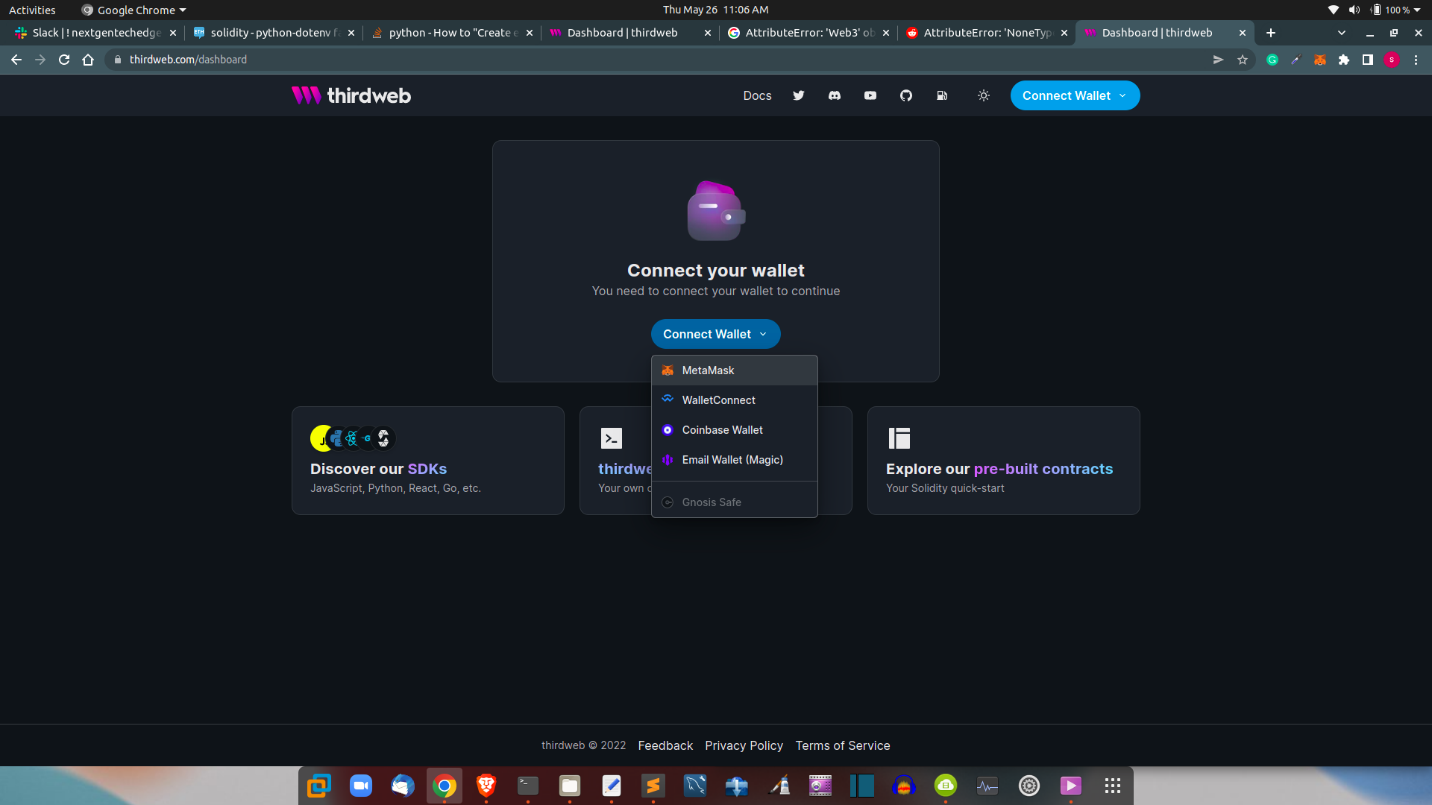
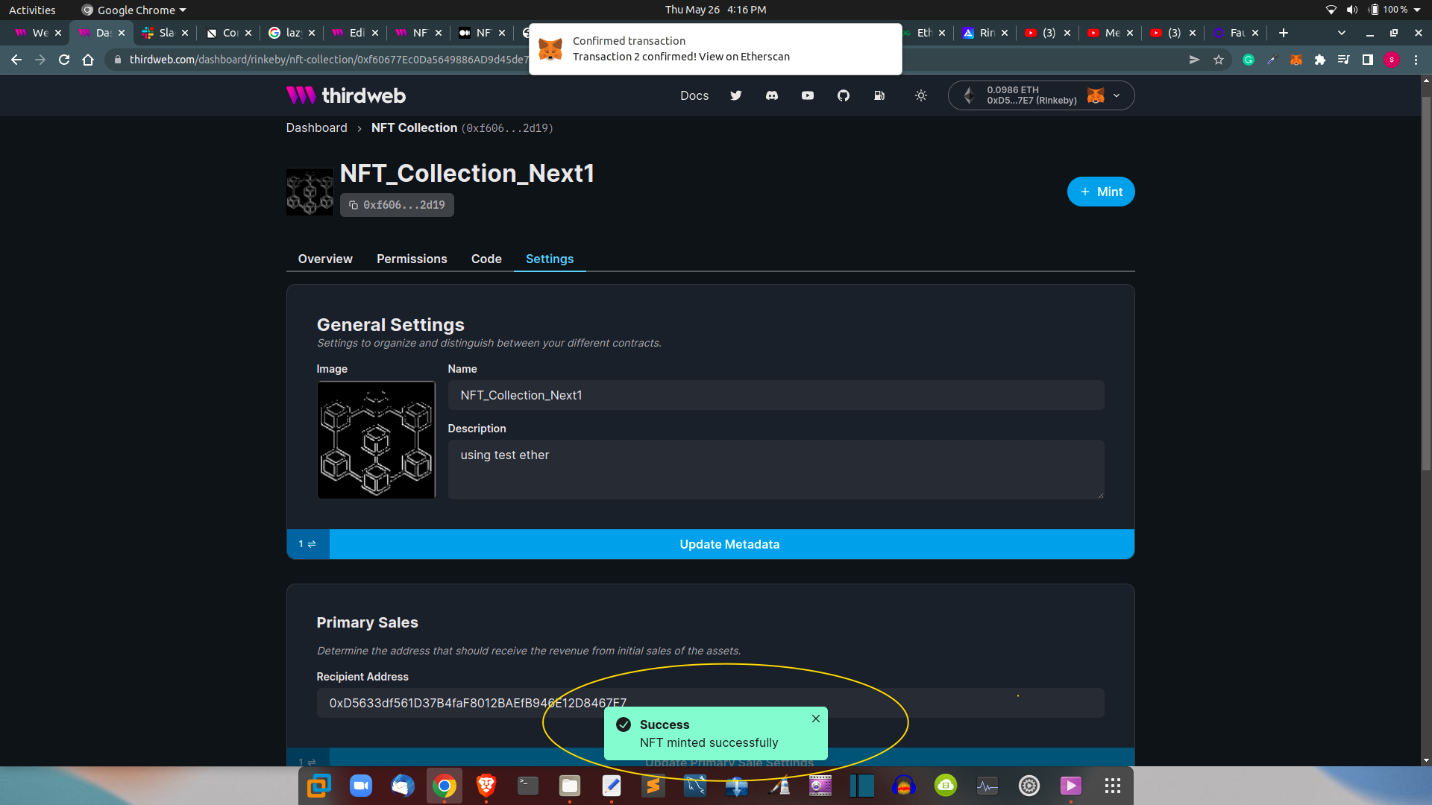
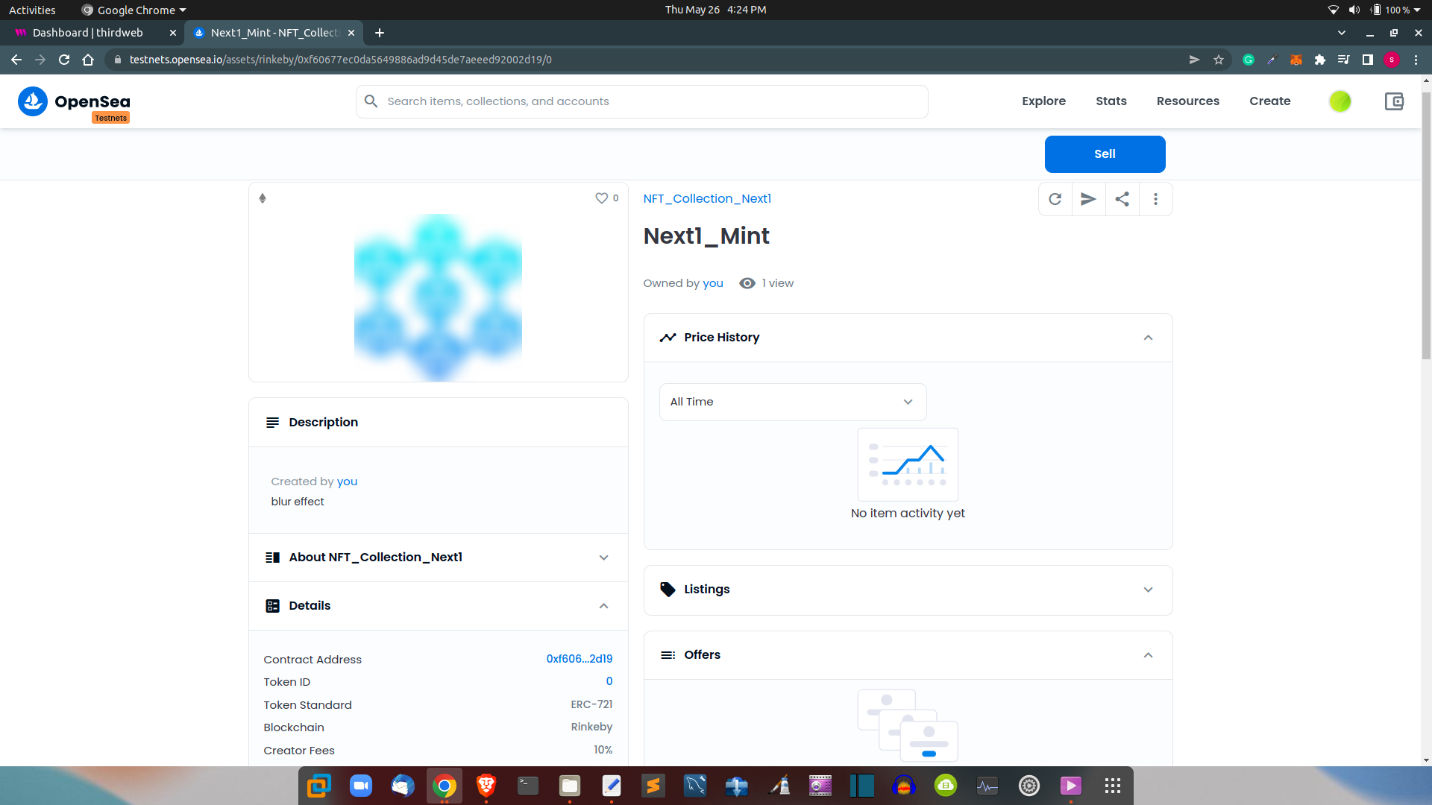
Genuine interface captures and developer workflow documentation drawn directly from technical project records on Ethereum testnets:
 Enlarge
Thirdweb wallet connection, non-custodial authentication, and smart contract configuration dashboard showing multi-wallet support (MetaMask, Coinbase Wallet, WalletConnect).
 Enlarge
NFT collection parameterization (NFT_Collection_Next1) on Ethereum testnet with on-chain transaction receipt confirmation ("Transaction 2 confirmed! View on Etherscan").
 Enlarge
On-chain token verification on OpenSea Testnet confirming ERC-721 token standards, contract ownership, decentralized metadata retrieval, and secondary listing capability.
Distinguishing between technologies proven in this project and our broader engineering capabilities across the decentralized ecosystem:
Smart contract development & EVM logic
Contract bridge & wallet connection
Backend orchestration & API services
Unique non-fungible token contract
Multi-token batch transfer architecture
Decentralized asset & metadata pinning
Rinkeby / Sepolia deployment & verification
MetaMask, Coinbase Wallet & WalletConnect
JSON-RPC communication & event parsing
We engineer enterprise-grade decentralized capabilities that solve verifiable business requirements, eliminate reconciliation friction, and create transparent digital value.
Custom minting interfaces, collection management systems, non-custodial wallet integration, metadata pipelines, and marketplace integration for enterprise brands and digital creators.
Discuss NFT Platforms →Custom Solidity contracts, token standard implementations (ERC-20, ERC-721, ERC-1155), application-specific business rules, deployment automation, and comprehensive testing.
Discuss Smart Contracts →Connect existing SaaS platforms, enterprise ERPs, and customer-facing mobile applications with blockchain functionality without migrating your underlying application stack.
Discuss Web3 Integration →Tokenized memberships, digital certifications, token-gated access passes, and verifiable digital ownership workflows, designed within applicable regulatory frameworks.
Discuss Tokenization →Tamper-evident supply-chain audit trails, product authenticity verification, immutable document integrity logs, and multi-party consortium tracking ledgers.
Discuss Provenance →Maintain existing Web3 applications, upgrade deprecated RPC providers and SDKs, improve transaction reliability, reduce gas consumption, and review security controls.
Discuss Modernization →Blockchain is not a universal replacement for databases. It provides measurable business value specifically where independent verification, shared trust, and tamper-evident history are required across organizational boundaries:
Academic degrees, professional accreditations, and industry licenses stored as tamper-proof on-chain tokens, allowing employers and regulators to instantly verify authenticity without contacting issuing institutions.
Luxury goods, pharmaceuticals, and critical aerospace components paired with decentralized digital passports that track manufacturing origin, custodial handoffs, and maintenance history.
Interoperable loyalty rewards, tiered club memberships, and VIP access rights managed via non-custodial tokens that users truly control and can seamlessly redeem across partner ecosystems.
In-game assets, character skins, and limited-edition digital collectibles with provable scarcity, verifiable attributes, and player-owned secondary marketplace liquidity.
Token-gated API keys, proprietary research access, digital rights management, and enterprise software licenses verified directly via wallet signatures without centralized subscription servers.
Legal contracts, compliance disclosures, and environmental ESG telemetry hashed and timestamped on-chain, creating indisputable proof of existence and non-repudiation.
We counsel enterprise clients with technical transparency: a relational database (such as PostgreSQL) is significantly faster, cheaper, and simpler when data is managed within a single trusted organization. Blockchain is specifically recommended when multi-party consensus, public verifiability, censorship resistance, or trustless ownership transfers provide a tangible strategic benefit.
Because smart contract state changes are irreversible, security must be built into the architectural foundation rather than applied as an afterthought.
Zero private keys are stored on web servers. Client operations use non-custodial browser signing; server administrative transactions use hardware security modules (HSMs).
Strict role-based access modifiers (OpenZeppelin AccessControl) and multi-signature requirements on all administrative and minting functions.
Multi-provider RPC failover (Alchemy, Infura, private fallbacks) with automatic retry and rate-limiting to prevent transaction submission outages.
Asynchronous event listeners wait for verified block depth before updating relational databases, guarding against short-term chain reorganizations.
Verified milestones established through hands-on technical development on Ethereum testnets:
Authored and compiled application-specific smart contract logic adhering to EVM standards, supporting parameterization, access controls, and event logging.
Engineered multi-stage minting pipelines executing parameterized token generation across ERC-721 and ERC-1155 token standards with on-chain receipts.
Integrated Thirdweb developer SDKs to abstract RPC complexity, streamline ABI compilation, and establish reliable contract connection interfaces.
Connected backend business validation, allowlist authorization, and API services with blockchain transaction triggers without disrupting traditional logic.
Implemented client-side wallet connectors for MetaMask, Coinbase Wallet, and WalletConnect with secure signature dispatch and error recovery.
Structured standardized asset descriptors and established deterministic decentralized pinning to IPFS, ensuring immutable content preservation.
Direct answers to key technical and architectural questions regarding smart contract development, Web3 integration, and decentralized applications:
Yes. NextGen TechEdge designs, develops, and tests custom Solidity smart contracts for EVM-compatible blockchains. Our engineering spans application-specific business logic, token implementations (ERC-20, ERC-721, ERC-1155), role-based access control, gas optimization, and comprehensive testing using frameworks like Hardhat and Foundry.
Yes. Rather than requiring an entirely separate Web3 infrastructure, we specialize in bridging traditional architectures with decentralized networks. We connect Python/Django backends to smart contracts via SDKs (such as Thirdweb or Web3.py) and integrate non-custodial wallet connections (MetaMask, WalletConnect) into React and modern JavaScript frontends.
ERC-721 is the standard for discrete, globally unique non-fungible tokens where each token has distinct metadata and ownership records. ERC-1155 is a multi-token standard capable of managing fungible, semi-fungible, and non-fungible tokens within a single contract, offering significantly reduced gas costs for batch transfers and multi-edition assets.
Yes. We engineer end-to-end NFT solutions including custom minting frontends, allowlist verification, decentralized metadata generation on IPFS, non-custodial wallet connectivity, smart contract deployment, and secondary marketplace integration.
The choice depends on transaction throughput, gas budget, security requirements, and target audience. Ethereum Mainnet offers the highest security and liquidity for flagship digital assets, while Layer-2 networks (Arbitrum, Optimism, Base) and EVM sidechains (Polygon) provide sub-second transaction finality and minimal gas costs ideal for high-volume enterprise operations.
We follow strict non-custodial security principles: users sign transactions directly within their browser or mobile wallet (e.g. MetaMask, Coinbase Wallet), meaning private keys never touch or pass through application servers. For server-initiated transactions, we employ dedicated Key Management Services (AWS KMS, GCP Cloud KMS) or hardware security modules with strict multi-sig authorization.
Yes. We assist organizations with reviewing existing contracts, refactoring integration backends, migrating deprecated RPC endpoints, updating Web3 client libraries, and implementing upgradeable proxy architectures (such as UUPS or Diamond patterns) where business logic requires evolution.
Because smart contracts are immutable once deployed, we apply rigorous defense-in-depth: unit and integration testing with 100% branch coverage, reentrancy guards, checks-effects-interactions patterns, static analysis using Slither, testnet staging on Sepolia/Amoy, and strict role-based access controls.
Blockchain is appropriate when independent verifiability, multi-party trust without a central intermediary, cryptographic provenance, or tamper-evident audit trails are necessary. If high-throughput (thousands of TPS), private data privacy, or frequent mutable updates are the primary requirement, a conventional PostgreSQL, Redis, or cloud-native database is significantly more cost-effective and performant.
Yes. Through our Dedicated Software Development Teams offering, NextGen provides pre-vetted senior Solidity engineers, Web3 full-stack developers, and Python/Django backend architects integrated directly into your agile delivery workflow.
Whether you need custom Solidity contracts, NFT minting functionality, wallet integration, or blockchain capabilities within an existing application, NextGen TechEdge can help evaluate the architecture and engineering requirements.
Explore how NextGen TechEdge delivers complex distributed platforms, application security, and dedicated engineering across industries: