 Enlarge
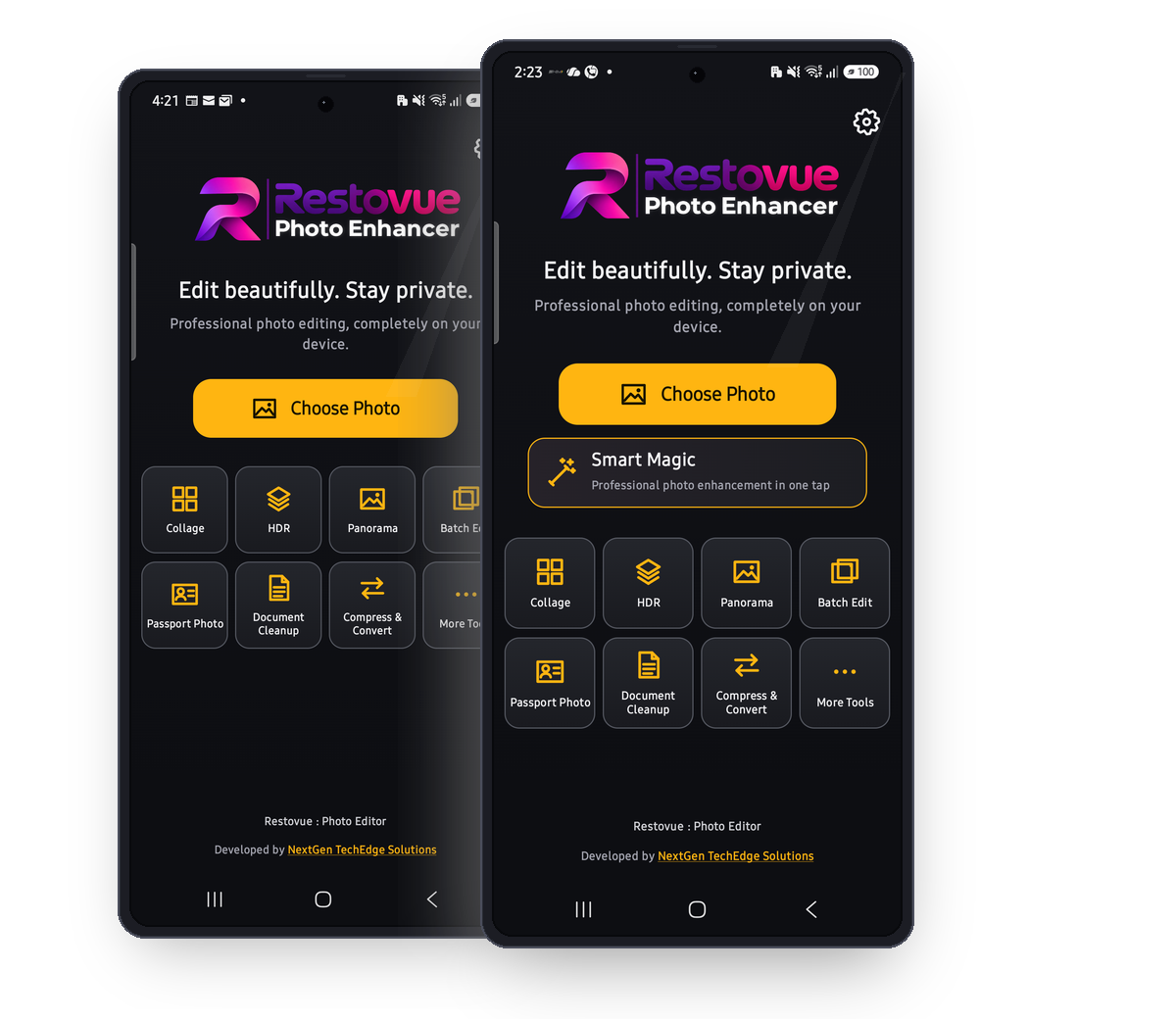
01 — Conceptual modern Ultra device composition presenting authentic Restovue editing drawer and Smart Magic one-tap enhancement engine.
Deterministic linear-light computational photography. 100% on your phone.
Conceptual modern Ultra device frames showing genuine Restovue interface captures: Home adjustment drawer (left) and Smart Magic linear floating-point enhancement engine (right). Device frame is conceptual art direction; UI screen captures are genuine Android application records.
In-house product developed by NextGen TechEdge Solutions. Planned for free download on Google Play (Google Play — Coming soon).
Everyday consumer photo editing is increasingly dominated by cloud-tethered applications that silently upload personal photographs to remote AI inference servers. Restovue was engineered as an internal product initiative to prove that studio-grade computational enhancement, tonal recovery, and non-destructive image adjustments can run entirely on consumer mobile hardware with absolute privacy and zero network dependency.
Implementing an uncompromising computational photography engine on mid-range Android devices presents severe technical constraints. Memory budgets on 3GB–4GB RAM devices cannot accommodate unrestricted 32-bit floating-point arrays for 12MP+ sensor captures without risking out-of-memory crashes. Furthermore, applying global saturation and contrast boosts frequently degrades human subjects, introducing unnatural orange casts or blown specular skin highlights. The engineering challenge required a deterministic, low-latency linear-light pipeline with mathematical skin-tone protection and strict memory guarding running purely on device CPU.
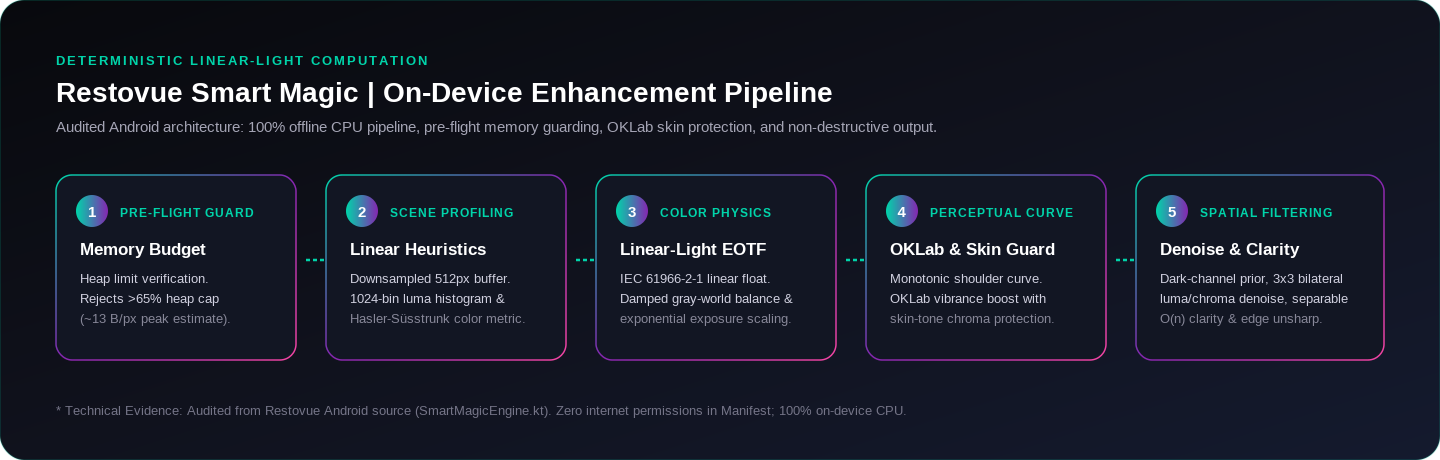
Restovue combines intuitive geometry editing with the custom-engineered Smart Magic Engine—a 10-stage linear-light processing pipeline executing entirely in native Kotlin code:
1. Pre-Flight Heap Budgeting: Prior to allocation, the engine queries Runtime.getRuntime().maxMemory() and projects a peak allocation footprint of approximately 13 bytes per pixel (input ARGB_8888 bitmap, linear float working buffers, and output arrays). If projected requirements exceed 65% of the available heap ceiling, the task safely aborts with clear user guidance rather than silently downsampling or crashing with an OOM exception.
2. Downsampled Scene Profiling: A rapid 512px downsampled buffer evaluates a 1024-bin linear-luminance histogram (extracting percentiles P01 through P99) alongside Hasler-Süsstrunk colorfulness metrics and spatial distribution heuristics to classify exposure balance and sky/foliage regions.
3. Linear-Light Conversion: Standard sRGB input is transformed to linear floating-point color space using the exact IEC 61966-2-1 electro-optical transfer function (EOTF), ensuring subsequent exposure scaling (Cout = Cin · 2EV) and confidence-weighted gray-world white balance operate on physically accurate light ratios.
4. Perceptual Curve & OKLab Protection: A monotonic rational shoulder curve compresses extreme highlights while recovering shadow depth. Saturation and vibrance modulation is performed in the perceptual OKLab color space (L, a, b), applying strict chroma dampening across warm hue ranges (20°–70°) to prevent facial skin tones from shifting toward unnatural orange or clipping.
5. Spatial Detail & Filtering: A 3×3 Dark-Channel Prior removes haze, followed by bilateral luma/chroma noise reduction, separable O(n) dual-pass box blur for midtone clarity, and edge-gradient-masked unsharp sharpening.
Your photos stay on your phone. Restovue operates with zero network permissions (no android.permission.INTERNET in AndroidManifest.xml) and processes all imagery locally on device hardware.
No analytics tracking, no crash telemetry with photo attachments, and no remote model downloads. All heap allocations are transient and purged upon export.
Genuine project captures and architecture documentation drawn directly from technical project records:
Enlarge
01 — Conceptual modern Ultra device composition presenting authentic Restovue editing drawer and Smart Magic one-tap enhancement engine.
 Enlarge
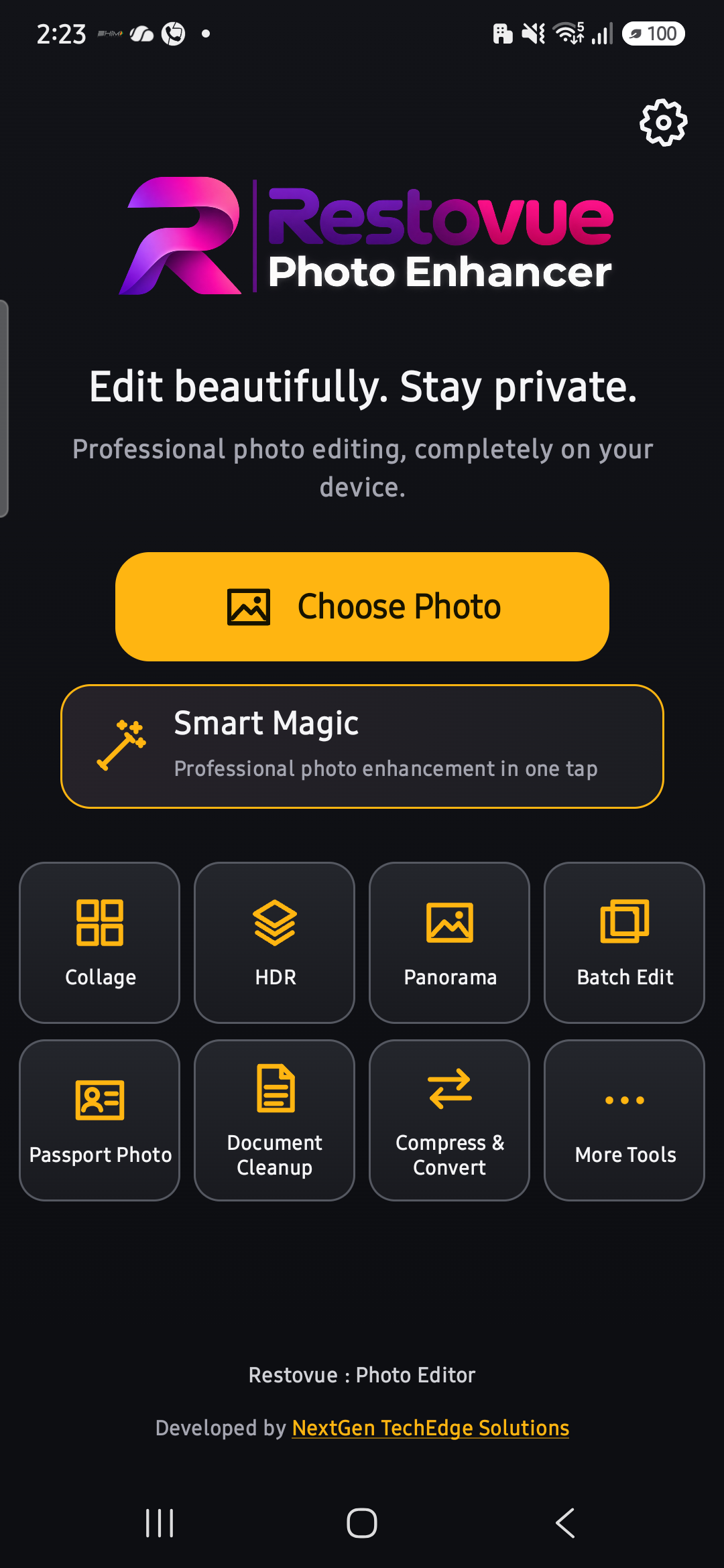
02 — Authentic Restovue Smart Magic one-tap enhancement interface featuring Natural, Enhanced, and Extreme intensity presets.
 Enlarge
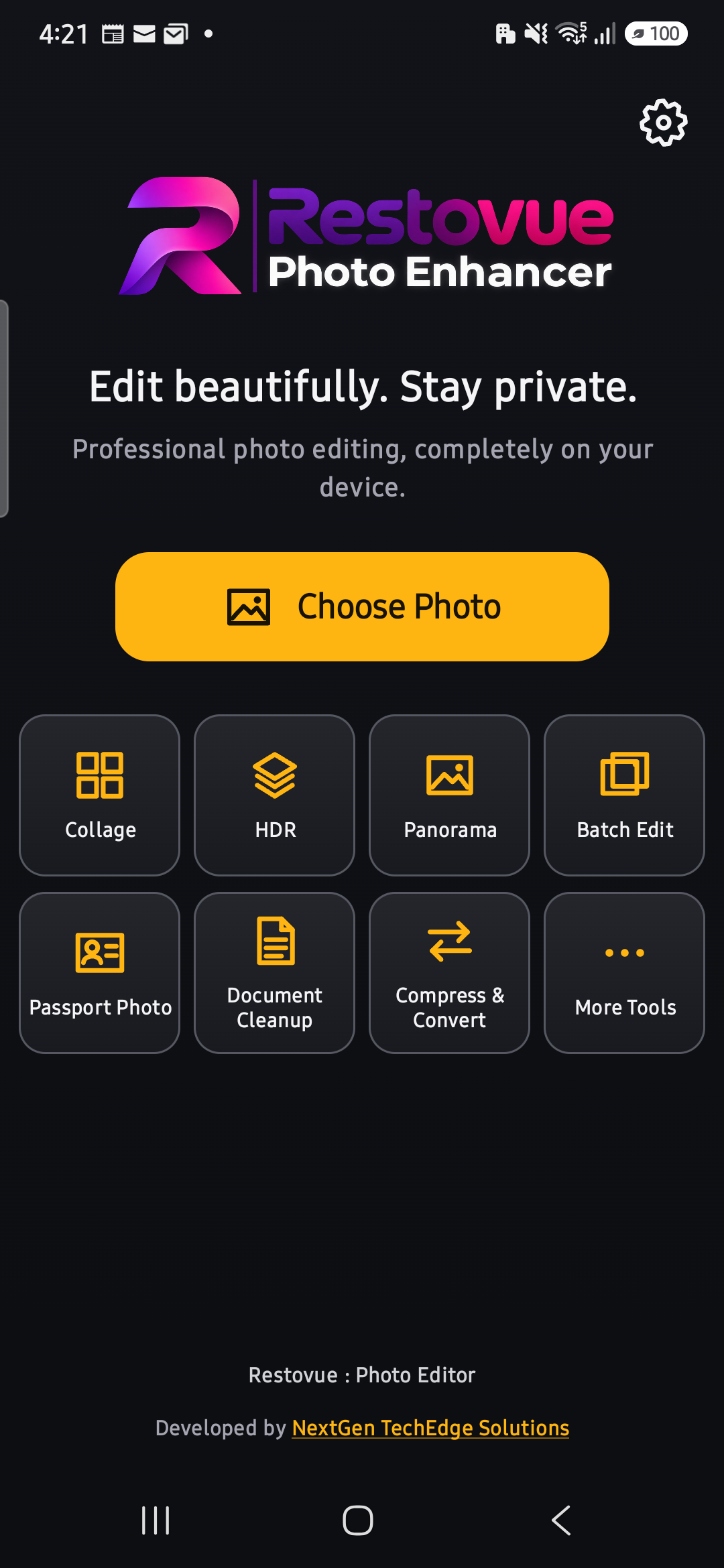
03 — Authentic Restovue adjustment tools showing non-destructive crop, rotate, exposure, and color calibration controls.
 Enlarge
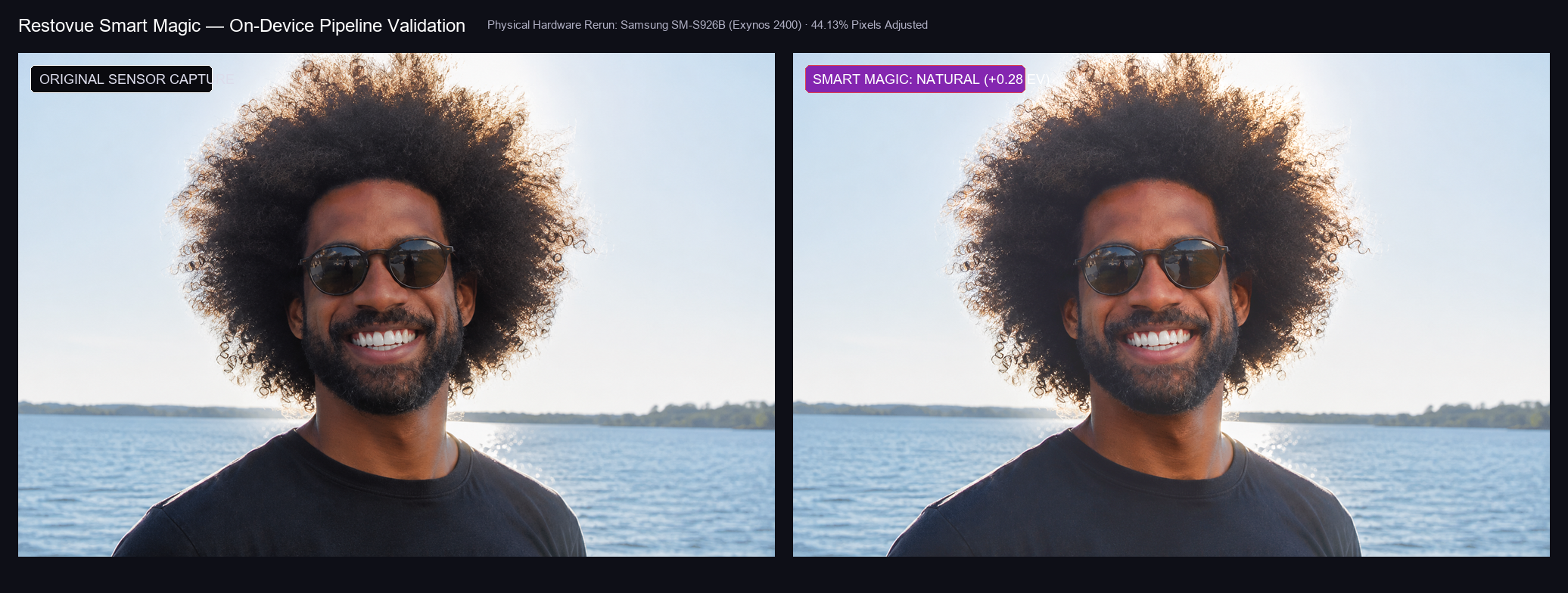
04 — Authentic physical device validation rerun (Samsung SM-S926B): Unaltered sensor capture vs. Smart Magic Natural output (+0.28 EV bounded exposure adjustment; 44.13% pixels changed with backlit fine-hair boundary preserved).
To substantiate Restovue's color science without synthetic marketing claims, the Smart Magic pipeline was executed against standardized diagnostic test fixtures on target physical hardware (Samsung Galaxy SM-S926B). Below is an authentic before/after pair documenting on-device exposure normalization and fine-hair boundary preservation:
Unaltered 1536×1024 sensor input exhibiting strong backlight underexposure on subject face and fine hair.
Authentic pipeline export: +0.28 EV bounded face exposure lift, zero shadow chroma noise, 44.13% changed pixels.
The Smart Magic engine was verified across real Android hardware, including mid-range devices like the Realme Pad (MediaTek Helio G80 octa-core, 3GB/4GB RAM) and Google Pixel hardware. On an 8-core Helio G80, CPU-based execution completes in approximately 3.2 to 7.8 seconds for a 12MP image, maintaining deterministic, artifact-free linear calculations without requiring cloud servers.
Documented technologies, frameworks, and protocols utilized across this domain:
Restovue is engineered as a modern native Android application prioritizing local linear-light image processing, responsive UI rendering, and strict memory safety.
| Technology | Role / Component |
|---|---|
| Kotlin | Native Android application logic, memory management, and concurrent coroutine execution |
| Jetpack Compose | Declarative, responsive UI with touch gesture handling and smooth split-screen sliders |
| Android SDK | Platform integration, SAF file persistence, and bitmap decode/encode |
| Linear sRGB (IEC 61966-2-1) | Accurate floating-point color physics for exposure and balance adjustments |
| OKLab Color Space | Perceptual uniform vibrance boosting with dedicated warm-hue skin tone dampening |
| Spatial Filtering Suite | Dark-Channel Prior, bilateral luma/chroma denoise, and O(n) box blur clarity |
| Physical Instrumentation | Automated on-device testing across Realme Pad (Helio G80) and Google Pixel devices |
Restovue is planned for free download on Google Play, bringing offline, privacy-first photo editing to a wider audience. The application demonstrates NextGen TechEdge Solutions' approach to thoughtful mobile interfaces, practical engineering, and privacy-conscious client-side architecture.